Difference Between Dwarflabs Dwarf III and Thermal Master P1 Mobile Thermal Camera Explained
In the rapidly evolving landscape of specialized imaging, consumers and professionals alike are finding themselves at a crossroads between two distinct yet equally fascinating frontiers of photography: deep-space astrophotography and high-precision thermal imaging. The choice between the Dwarflabs Dwarf III and the Thermal Master P1 Mobile Thermal Camera represents a choice between looking outward toward the cosmos or looking inward at the heat signatures of the world around us. While both devices fall under the broad umbrella of specialized digital imaging, they serve entirely different purposes, utilize vastly different sensor technologies, and target different user demographics. Understanding the nuances of these two tools is essential for anyone looking to expand their visual capabilities beyond the visible spectrum or the limits of traditional handheld optics.
The Dwarflabs Dwarf III is the latest iteration in a line of smart telescopes that have revolutionized the way amateur astronomers interact with the night sky. By automating the complex processes of star alignment, tracking, and long-exposure stacking, it democratizes a hobby that was once gatekept by steep learning curves and heavy equipment. On the other hand, the Thermal Master P1 Mobile Thermal Camera represents the pinnacle of portable thermography—a compact add-on for smartphones that translates infrared radiation into visible color maps, revealing hidden leaks, mechanical failures, and biological heat signatures. Though they share a compact, portable philosophy, their technical architectures and the data they produce are world apart.
Detailed Product Analysis: Dwarflabs Dwarf III
The Dwarflabs Dwarf III is a smart, all-in-one telescope designed to bridge the gap between traditional astrophotography and modern smartphone convenience. At its core, the Dwarf III is a dual-lens system. One lens provides a wide-angle view for orientation and landscape shots, while the telephoto lens is optimized for capturing celestial objects like nebulae, galaxies, and star clusters. Unlike traditional telescopes that require a physical eyepiece, the Dwarf III is entirely digital. It streams its view directly to a smartphone or tablet via a dedicated app, which serves as the command center for the device.
The standout feature of the Dwarf III is its internal processing power. Utilizing advanced AI-driven algorithms, the telescope can automatically identify its orientation in the sky by "plate solving"—matching the stars it see against a database of millions of celestial coordinates. Once aligned, it can autonomously slew to any object the user selects from a menu. To combat the Earth's rotation, which causes stars to "streak" during long exposures, the Dwarf III features a computerized alt-azimuth mount that tracks objects with high precision. This allows the sensor to collect light over several minutes, which the internal software then "stacks" to reduce noise and bring out the vibrant colors of deep-space objects that are invisible to the naked eye.
Beyond the stars, the Dwarf III is marketed as a versatile tool for wildlife photography and birdwatching. Its compact size makes it an ideal companion for hikers and nature enthusiasts who want the reach of a powerful telephoto lens without the bulk of a full-frame DSLR setup. The AI tracking isn't limited to stars; it can also lock onto moving subjects like birds or distant animals, making it a multi-purpose tool for observing the natural world.
Pros and Cons of the Dwarflabs Dwarf III
- Pro: Extreme ease of use for beginners, removing the need for manual polar alignment or complex star charts.
- Pro: Compact and highly portable design that fits easily into a small backpack, unlike traditional GoTo telescope mounts.
- Pro: Dual-camera system allows for simultaneous wide-angle context and telephoto detail capturing.
- Pro: Integrated AI features for automatic subject tracking and image enhancement through real-time stacking.
- Con: Limited aperture size compared to full-sized telescopes, which limits the resolution of very faint or distant objects.
- Con: Dependency on a smartphone app and Wi-Fi/Bluetooth connectivity for all operations.
- Con: Fixed focal length means you cannot swap lenses for different magnification levels.
Detailed Product Analysis: Thermal Master P1 Mobile Thermal Camera
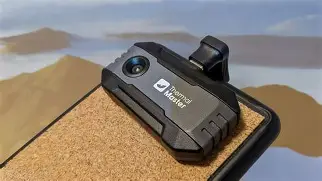
The Thermal Master P1 is a sophisticated piece of thermographic equipment designed to plug directly into the charging port of a mobile device. Unlike the Dwarf III, which operates in the visible light spectrum (and slightly into the near-infrared for certain celestial filters), the P1 operates in the Long-Wave Infrared (LWIR) spectrum. This allows it to detect heat—the infrared energy emitted by all objects above absolute zero—and convert that energy into a visual representation known as a thermogram.
The P1 is built around a high-resolution microbolometer sensor. In the world of mobile thermal cameras, resolution is king, and the P1 prides itself on providing a crisp image that allows users to distinguish between small temperature variations over a distance. This is not just about seeing "hot and cold"; it is about precision. The device can measure temperatures with a high degree of accuracy, often within two degrees Celsius, making it a viable tool for professional inspections. The software interface allows for various color palettes (such as Ironbow, Rainbow, or Grayscale) and the ability to set temperature alarms or point-measurements in real-time.
One of the primary advantages of the Thermal Master P1 is its lack of a built-in battery. By drawing a negligible amount of power from the host smartphone, it remains incredibly lightweight and eliminates the need for separate charging cycles. It is designed for immediate deployment. Whether an electrician is searching for a loose wire sparking in a junction box, a homeowner is looking for missing insulation in a wall, or a veterinarian is checking a horse's leg for inflammation, the P1 provides instant, non-invasive diagnostic data that a standard camera simply cannot see.
Pros and Cons of the Thermal Master P1
- Pro: High thermal sensitivity and resolution for its class, allowing for clear identification of thermal anomalies.
- Pro: Extremely compact and "plug-and-play" functionality with no internal battery to maintain.
- Pro: Professional-grade analysis tools within the app, including area measurements and isotherm settings.
- Pro: Robust build quality capable of withstanding the rigors of worksite inspections.
- Con: Short range compared to optical cameras; thermal cameras are generally used for subjects within 50-100 feet.
- Con: Blocks the phone's charging port during use, which can be an issue during long inspection sessions.
- Con: Thermal imaging requires a basic understanding of emissivity and reflection to interpret data accurately.
Core Differences: Astronomy vs. Thermography
The fundamental difference between these two devices lies in what they are looking for. The Dwarf III is designed to collect as much light as possible from massive objects located light-years away. It is a tool of magnification and light accumulation. The Thermal Master P1, conversely, is a tool of detection. It doesn't care about light; it cares about the kinetic energy of molecules vibrating in an object, which we perceive as heat.
Discover deals on Cameras & Photography — updated daily.
View Offers →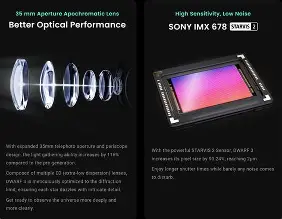
This leads to a massive disparity in how the images are used. A Dwarf III image is usually a highly aesthetic piece of art—a beautiful photo of the Orion Nebula or the surface of the Moon. A Thermal Master P1 image is usually a piece of data—a map showing exactly where heat is escaping a building or where a circuit board is overheating. One is for exploration and wonder, the other is for diagnostics and problem-solving.
Comparison Table: Technical Specifications and Use Cases
| Feature | Dwarflabs Dwarf III | Thermal Master P1 |
|---|---|---|
| Primary Function | Smart Astrophotography & Wildlife | Mobile Thermal Imaging & Diagnostics |
| Sensor Type | CMOS (Visible Light/Near-IR) | Uncooled Microbolometer (LWIR) |
| Magnification | High Optical/Digital Zoom | Minimal (Wide-angle focus) |
| Connectivity | Wireless (Wi-Fi/Bluetooth) | Direct Plug-in (USB-C/Lightning) |
| Subject Distance | Meters to Light-Years | 0.1 Meters to ~100 Meters |
| AI Capabilities | Star Tracking, Object Recognition | Temperature Analytics, Alarm Triggers |
| Power Source | Internal Rechargeable Battery | Draws power from Smartphone |
Real-World Use Cases
To truly understand which device fits a user's needs, we must look at how they perform in the field. Imagine a homeowner on a cold winter night. If that homeowner takes the Dwarflabs Dwarf III outside, they are likely setting it on a tripod in the backyard. They are aiming it at Jupiter to see its atmospheric bands or perhaps at the Pleiades star cluster. Their goal is to spend an hour "stacking" frames to produce a crystal-clear image of the heavens. Success for them is a photograph that reveals the hidden depths of space.
If that same homeowner takes the Thermal Master P1 outside on that same night, they aren't looking at the sky. They are looking back at their own house. They are scanning the windows, the door frames, and the roofline. With the P1, they can see bright yellow and white streaks where expensive heat is leaking out of the house into the cold night air. They might point it at the breaker panel to ensure no switches are running dangerously hot. Success for them is identifying a problem that needs to be fixed to save money on energy bills or prevent a fire.
In a professional context, the Dwarf III might be used by an educator to show a classroom the wonders of the solar system without the frustration of traditional optical alignment. Meanwhile, the Thermal Master P1 would be in the tool belt of a mechanical engineer or a home inspector who needs to "see" through walls to find moisture or electrical faults without tearing down drywall.
Buying Guide: Which Camera Is Right for You?
Choosing between these two devices requires an honest assessment of your interests and professional needs. Since they operate in entirely different realms of physics, the "best" camera is purely subjective to the task at hand. Below are the factors you should consider before making a decision.
Who Should Buy the Dwarflabs Dwarf III?
The Dwarf III is the ideal choice for individuals who have always felt intimidated by the complexity of astronomy. If you find the idea of manual telescopes, heavy mounts, and the math of polar alignment exhausting, this smart telescope is built for you. It is also a fantastic choice for nature photographers who want a compact, robotic telephoto lens for birding. If your primary goal is to capture the beauty of the universe and share high-quality images of celestial bodies on social media or with friends, the Dwarf III is your best bet.
Buyers should care about the software ecosystem. Since the Dwarf III is essentially a computer with a lens, the quality of the app updates and the community support for the "smart" features are just as important as the hardware itself. If you enjoy a "set it and forget it" workflow where the technology handles the heavy lifting, the Dwarf III will feel like a futuristic marvel.
Who Should Buy the Thermal Master P1?
The Thermal Master P1 is for the pragmatist, the professional, and the DIY enthusiast. If you are a contractor, an electrician, or a plumber, this device is a literal superpower that allows you to see the invisible. It is also a high-value tool for outdoor enthusiasts and hunters who want to track blood trails or spot wildlife in total darkness based on heat signatures. Unlike night vision, which requires some ambient light, the P1 works in 100% darkness because it relies on heat.
When buying a thermal camera like the P1, you should prioritize specs like thermal sensitivity (usually measured in mK or milli-Kelvins) and pixel resolution. The higher the resolution, the further away you can accurately read temperatures. If you need a diagnostic tool that provides actionable data for home maintenance, security, or professional work, the P1 is an indispensable addition to your smartphone's toolkit.
Discover deals on Cameras & Photography — updated daily.
Browse Now →Logistical Considerations
Consider your mobile device compatibility. The Dwarf III communicates wirelessly, so as long as your phone can run the app, you are good to go. However, the Thermal Master P1 requires a physical connection. You must ensure you choose the version that matches your phone's port (USB-C for most modern Androids and the iPhone 15/16 series, or Lightning for older iPhones). Furthermore, consider the environment. The Dwarf III thrives in clear, dark skies away from city lights, while the Thermal Master P1 is effective in any lighting condition, including broad daylight or pitch-black basements.
Advanced Insights on Imaging Technology
It is worth noting that both devices represent a trend toward "computational photography." In the case of the Dwarf III, the "image" you see isn't just one snapshot; it is the result of hundreds of images being mathematically combined to cancel out noise. This process, known as Signal-to-Noise Ratio (SNR) optimization, is what allows such a small lens to compete with much larger traditional telescopes. This reliance on software means the camera actually gets better over time as the manufacturers release firmware updates that improve the stacking algorithms.
The Thermal Master P1 uses a different kind of computational magic called "multi-spectral imaging" or "image blending" in its app. Many mobile thermal cameras can use the phone’s standard visible-light camera to find the edges of objects and then overlay the thermal data on top of it. This provides much-needed context to the thermal image. Without this, a thermal photo of a wall might just look like a blurry orange blob; with it, you can clearly see the outline of the studs and the electrical outlets, making the temperature data much easier to interpret.
A buyer might also care about the field of view (FOV). The Dwarf III has a very narrow FOV on its telephoto lens (around 3 degrees), which is necessary for looking at small, distant objects like the Ring Nebula. The Thermal Master P1 typically has a much wider FOV (around 40 to 50 degrees), which is necessary because you are often using it in confined spaces to look at large objects like a furnace or an entire exterior wall. This reflects their divergent philosophies: one is for the "micro" view of the infinite, and the other is for the "macro" view of the immediate.
Conclusion
The Dwarflabs Dwarf III and the Thermal Master P1 Mobile Thermal Camera are two of the most exciting examples of how specialized sensor technology has been shrunk down for the average consumer. They are, however, tools for different worlds. The Dwarf III is a gateway to the stars, turning the ancient art of astronomy into a streamlined, digital experience that fits in the palm of your hand. It satisfies our innate curiosity about the cosmos and provides a creative outlet for capturing the splendor of the night sky.
The Thermal Master P1 is a gateway to the unseen world of energy surrounding us. It turns your smartphone into a powerful diagnostic instrument capable of uncovering hidden defects, improving home efficiency, and even aiding in search and rescue or wildlife observation. It satisfies our need for practical information and provides a level of safety and insight that visible light simply cannot offer.
Ultimately, the choice doesn't come down to which camera is "better," but rather which direction you want to point your lens. If you want to spend your nights exploring galaxies and your days tracking distant wildlife, the Dwarf III is an unparalleled companion. If you want to spend your time solving real-world problems and gaining a new perspective on the heat signatures of the objects and environments around you, the Thermal Master P1 is the superior choice. Both represent the incredible power of modern portable imaging, proving that there is always more to see if you have the right sensor for the job.